
Starting an S-Corp in Pennsylvania can significantly reduce your self-employment tax burden while maintaining the liability protection of a formal business structure. Pennsylvania offers specific advantages for S-Corp owners, including no state-level S-Corp tax and a flat corporate income tax rate, making it an attractive option for self-employed individuals earning above certain thresholds. This comprehensive guide will walk you through everything you need to know about forming an S-Corp in Pennsylvania.
What is an S-Corp?
An S-Corp a federal tax election that allows eligible businesses to pass income through to their owners while potentially reducing self-employment taxes through a combination of salary and distributions.. An S-Corp avoids double taxation by having profits taxed only at the individual shareholder level. The primary benefit for self-employed individuals is the ability to split income between salary and distributions, potentially saving thousands of dollars in self-employment taxes annually.
An S-Corp is not a business entity itself but rather a tax election made with the IRS. You must first form either an LLC or corporation in Pennsylvania, then file Form 2553 with the IRS to elect S-Corp taxation. This structure allows you to pay yourself a reasonable salary, subject to employment taxes, while taking additional profits as distributions that are not subject to the 15.3% self-employment tax.
S-Corps in Pennsylvania Overview
Pennsylvania provides a favorable environment for S-Corps with its straightforward formation process and business-friendly tax structure. The state does not impose a separate S-Corp tax, and the flat corporate income tax rate applies uniformly across businesses.
Benefits of Filing as an S-Corp in Pennsylvania
The primary advantage of forming an S-Corp in Pennsylvania is self-employment tax savings. When you operate as a sole proprietor or standard LLC, you pay 15.3% self-employment tax on all net business income. With an S-Corp, you only pay employment taxes on your salary, while distributions avoid these taxes entirely. For someone earning $100,000 in business income, this difference can save over $5,000 annually.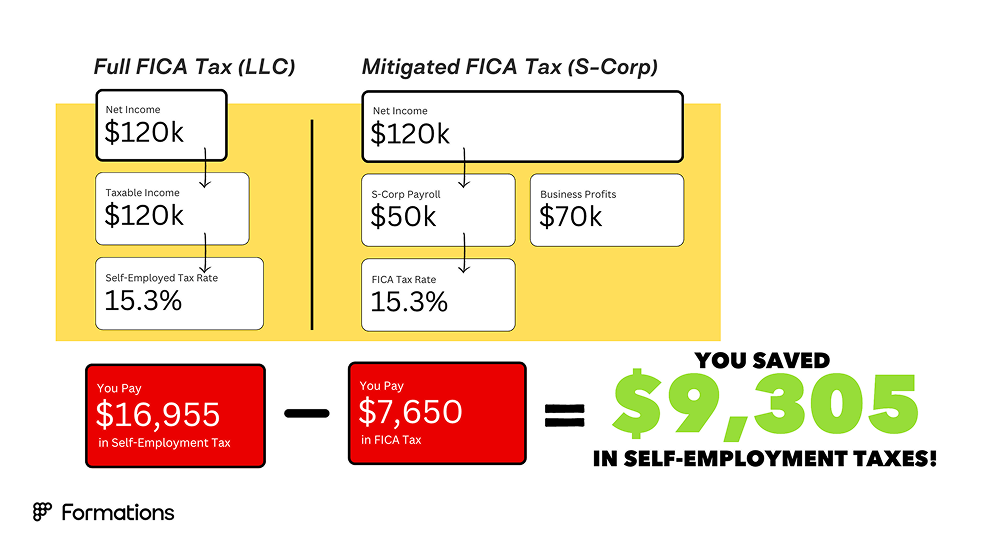
Pennsylvania does not impose a state-level S-Corp tax, which simplifies compliance compared to states that require separate S-Corp returns or taxes. The state's flat 8.99% Corporate Net Income Tax applies to C corporations, but S-Corp income passes through to shareholders and is taxed at Pennsylvania's 3.07% flat personal income tax rate. This pass-through treatment means you avoid entity-level state taxation.
Additional benefits include enhanced credibility with clients and vendors, easier transfer of ownership, and potential access to tax deductions available to S-Corps such as health insurance premiums and retirement contributions. The formal structure also provides liability protection, separating your personal assets from business debts and obligations.
Pennsylvania Requirements for Starting an S-Corp
To form an S-Corp in Pennsylvania, you must first establish either an LLC or corporation with the Pennsylvania Department of State. Your business must meet IRS requirements for S-Corp election, including having no more than 100 shareholders, only one class of stock, and shareholders who are U.S. citizens or residents. You'll need to file Form 2553 with the IRS within specific timeframes to elect S-Corp taxation.
Pennsylvania requires S-Corps to maintain a registered office in the state and designate a registered agent for service of process. You must also obtain an Employer Identification Number (EIN) from the IRS, open a business bank account, and register with the Pennsylvania Department of Revenue for state tax purposes. Proper corporate formalities include holding annual meetings, maintaining corporate records, and keeping personal and business finances completely separate.
S-Corp Set-Up and Maintenance Costs
The cost to form an LLC in Pennsylvania is $125 for the Articles of Organization filing fee with the Department of State. If you choose to form a corporation instead, the filing fee for Articles of Incorporation is also $125. There is no expedited processing fee option in Pennsylvania, and standard processing typically takes several weeks.
Annual renewal fees in Pennsylvania are relatively modest. LLCs that have elected S-Corp taxation must file an Annual Report with a $7 filing fee. Beyond state fees, you'll need to budget for federal and state tax preparation, payroll processing services, and potentially legal or accounting assistance to ensure proper compliance.
Beyond state fees, you'll need to budget for federal and state tax preparation, payroll processing services, and potentially legal or accounting assistance to ensure proper compliance. There is no federal filing fee to elect S-Corp status; the election is made by submitting Form 2553 with the IRS.
S-Corp Compliance Deadlines
Pennsylvania S-Corps must adhere to several important deadlines throughout the year. The IRS Form 2553 for S-Corp election must be filed no more than two months and 15 days after the beginning of the tax year you want the election to take effect, or at any time during the preceding tax year. If you miss this deadline, you may still qualify for a late S-election, which can allow the election to apply retroactively if IRS requirements are met.
S-Corps must file federal Form 1120-S by March 15 for calendar-year corporations, or by the 15th day of the third month after the tax year ends. An extension can be requested to extend the filing deadline to September 15. Pennsylvania also requires S-Corps to file Form PA-20S/PA-65 by the 15th day of the third month following the close of the tax year. Payroll taxes must be deposited on a schedule determined by your total tax liability, typically monthly or semi-weekly.
Steps for Filing as an S-Corp in Pennsylvania
This video breaks down the different steps required to become an S-Corp:
1. Form Your LLC or Corporation
The first step is establishing your business entity with the Pennsylvania Department of State. Most self-employed individuals choose to form an LLC due to its flexibility and simpler ongoing compliance requirements. You can file your Articles of Organization online through the PA Business One-Stop Shop portal at pa.gov or by mail with a paper application.
Your Articles of Organization must include your LLC name (which must include "Limited Liability Company," "LLC," or "L.L.C."), your registered office address in Pennsylvania, and your registered agent information. Choose a business name that's distinguishable from existing Pennsylvania businesses by searching the Department of State's business name database. Once approved, your LLC is officially formed as a Pennsylvania business entity.
2. Obtain an Employer Identification Number (EIN)
After forming your LLC or corporation, apply for an EIN through the IRS website. This nine-digit number serves as your business's tax identification number and is required to file Form 2553 for S-Corp election. The EIN application is free and can be completed online in minutes at irs.gov, with immediate issuance upon completion.
You'll need your EIN to open a business bank account, hire employees, file tax returns, and complete your S-Corp election. Keep your EIN confirmation letter in a safe place, as you'll reference this number frequently in business operations and tax filings.
3. File Form 2553 With the IRS
Form 2553, Election by a Small Business Corporation, is the document that converts your LLC or corporation to S-Corp tax status. The form requires basic information about your business, shareholders, and the effective date of your election. All shareholders must sign the form consenting to the S-Corp election.
Timing is critical when filing Form 2553. For your election to take effect in the current tax year, you must file within two months and 15 days of the start of your tax year, or at any time during the preceding year.
4. Register With Pennsylvania Department of Revenue
Pennsylvania requires S-Corps to register for state tax purposes with the Department of Revenue. You'll need to complete form PA-100, Pennsylvania Enterprise Registration Form, to register for state taxes including Corporate Net Income Tax reporting requirements and employer withholding accounts if you have employees (including yourself as an employee of your S-Corp).
This registration can be completed online through the PA Department of Revenue's website. Even though S-Corps don't pay Pennsylvania corporate income tax at the entity level, you must still file annual information returns. Registration ensures you receive proper forms and comply with Pennsylvania's reporting requirements.
5. Set Up Payroll and Pay Yourself a Reasonable Salary
As an S-Corp owner actively working in the business, you must pay yourself reasonable compensation through W-2 wages before taking distributions. The IRS scrutinizes S-Corp owners who take minimal salaries and large distributions to avoid employment taxes. Your salary should reflect what you would pay someone else to perform your job duties, considering your qualifications, time commitment, and industry standards.
Set up a payroll system to process your salary, withhold federal income tax, Social Security, Medicare, and Pennsylvania state income tax. You can use payroll software, hire a payroll service, or work with an accountant to ensure proper tax withholding and quarterly payroll tax deposits. Remember that your salary must be paid at least quarterly, though monthly or bi-weekly payment schedules are more common.
6. Maintain Corporate Formalities and Records
S-Corp business owners must maintain proper corporate records and observe formalities to preserve liability protection. This includes keeping detailed financial records, maintaining separate business bank accounts, documenting major business decisions, and holding annual meetings (even if you're the sole owner). Create meeting minutes for important decisions and maintain an organized record of all business transactions.
Failing to maintain corporate formalities can result in "piercing the corporate veil," where courts disregard your business structure and hold you personally liable for business debts. Keep personal and business expenses completely separate, never commingle funds, and document all transactions between yourself and your S-Corp. These practices protect your limited liability status and demonstrate legitimate business operations to the IRS.
7. File Annual Returns and Reports
S-Corps must file federal Form 1120-S annually by March 15, with an available extension that moves the deadline to September 15.. This information return reports the S-Corp's income, deductions, and credits, though no federal tax is due at the entity level. Each shareholder receives Schedule K-1 showing their share of income, which they report on their personal tax return.
Pennsylvania requires S-Corps to file Form PA-20S/PA-65, which is due April 15 for calendar-year filers. While Pennsylvania does not impose entity-level income tax on S-Corps, this return reports each owner’s share of pass-through income to the state. S-Corp owners must also file their Pennsylvania personal income tax return (PA-40) by April 15, and file an annual report with the Pennsylvania Department of State by June 30, along with the required filing fee.
S-Corp vs. LLC's
An LLC and an S-Corp serve different roles. An LLC is a legal business entity that provides liability protection and operational flexibility, while an S-Corp is a federal tax election that determines how a business is taxed. In Pennsylvania, business owners typically form an LLC first and then elect S-Corp taxation with the IRS.
A standard LLC (taxed as a sole proprietorship or partnership) offers simpler tax filing and fewer compliance requirements. You report business income on Schedule C of your personal tax return, avoiding corporate tax forms and payroll requirements. However, all net income is subject to the 15.3% self-employment tax. An LLC also provides complete flexibility in profit distribution and requires fewer formalities than a corporation.
How to Decide Between an S-Corp vs. LLC
Your decision between a standard LLC and S-Corp taxation depends primarily on your income level and business circumstances. If you're earning less than $60,000 annually, the administrative costs and complexity of an S-Corp likely outweigh the tax benefits. At this income level, a simple LLC taxed as a sole proprietorship provides adequate structure with minimal compliance burden.
How to Convert an LLC to an S-Corp in Pennsylvania
Converting your existing LLC to an S-Corp in Pennsylvania is straightforward and doesn't require changing your business entity with the state. You simply file Form 2553 with the IRS to elect S-Corp tax treatment while maintaining your LLC structure with the Pennsylvania Department of State.
Before filing Form 2553, ensure your LLC meets S-Corp requirements (you must have fewer than 100 members, only one class of stock, and all members must be U.S. citizens or residents). Submit Form 2553 with signatures from all LLC members within the required timeframe for your desired effective date. Once approved, update your Pennsylvania tax registrations, establish payroll to pay yourself reasonable compensation, and begin filing S-Corp tax returns. Your LLC remains legally unchanged with the Pennsylvania Department of State (only your federal and state tax treatment changes).
How Much Can You Save With an S-Corp in Pennsylvania
Actual tax savings from electing S-Corp status vary based on your business income, reasonable salary requirements, and individual tax situation. As a general rule, S-Corp owners save approximately 15.3% in self-employment taxes on the portion of income taken as distributions rather than salary. For example, if you earn $100,000 and pay yourself a $60,000 reasonable salary, you'd save about $6,120 in self-employment taxes on the $40,000 in distributions (15.3% × $40,000).
Pennsylvania's 3.07% flat personal income tax rate applies to both W-2 wages and S-Corp distributions, so there's no state-level tax difference. However, distributions avoid the 1.45% Medicare tax that applies to all W-2 wages, plus you avoid the employer portion of Social Security and Medicare taxes on distributions. The combination of federal self-employment tax savings creates substantial benefits for Pennsylvania S-Corp owners.
Calculate your potential savings using Formations' S-Corp tax savings calculator.
Pennsylvania S-Corp Frequently Asked Questions
How much does it cost to start an S-Corp in Pennsylvania?
Starting an S-Corp in Pennsylvania costs $125 to file your LLC or corporation with the Department of State, plus potential costs for registered agent services if you don't use your own address. Filing Form 2553 with the IRS is free, but you may want to hire an attorney or accountant to ensure proper formation and election, typically costing $500-$2,000. Ongoing costs include annual report fees ($7 for LLCs or $70 for corporations), payroll processing fees, and additional tax preparation costs for S-Corp returns.
Is it better to have an LLC or S-Corp in Pennsylvania?
Whether an LLC or S-Corp is better depends on your income and business needs. Most self-employed Pennsylvanians benefit from forming an LLC and electing S-Corp status once their income exceeds $60,000 annually. A standard LLC offers simplicity and lower administrative costs for new or lower-earning businesses. An S-Corp provides significant self-employment tax savings for higher earners but requires payroll processing, more complex tax filings, and stricter compliance with corporate formalities.
What is the deadline to form an S-Corp?
To be taxed as an S-Corp for a given tax year, you must file IRS Form 2553 no later than two months and 15 days after the start of that tax year (typically March 15 for calendar-year businesses), or at any time during the prior tax year. If you miss the deadline, you may still qualify for a late S-Corp election, which can allow the election to apply retroactively if IRS requirements are met.
What is reasonable compensation?
Reasonable compensation is the salary an S-Corp owner must pay themselves for services performed, based on what you would pay someone else with similar qualifications to do your job. The IRS examines factors including time devoted to the business, duties and responsibilities, training and experience, comparable salaries in similar businesses, and your business's income and financial condition. Setting salary too low to maximize distributions can trigger IRS scrutiny, reclassification of distributions as wages, and penalties plus back taxes.
Ready to Form Your S-Corp?
Starting an S-Corp in Pennsylvania offers substantial tax savings for self-employed individuals earning above certain income thresholds. The state's business-friendly environment, lack of entity-level S-Corp taxation, and straightforward formation process make Pennsylvania an excellent location for S-Corp owners. By following the steps outlined above and maintaining proper compliance, you can reduce your tax burden while protecting your personal assets.
Proper S-Corp setup and compliance require close attention to IRS rules, Pennsylvania regulations, and ongoing deadlines. Working with experienced professionals helps ensure your structure is optimized for tax savings while avoiding costly mistakes. Formations has helped thousands of self-employed professionals save an average of $14,801 through expert S-Corp formation and compliance support.
Get Started with Formations
Ready to explore whether an S-Corp is right for your business? Schedule a call with a Formations expert to see your potential tax savings and receive personalized guidance on forming and maintaining your S-Corp. Our specialists understand Pennsylvania's requirements and can help you maximize tax benefits while ensuring full compliance with federal and state regulations.