
With just a few weeks left in 2025, the window to reduce this year’s tax bill is quickly closing. But it’s not over yet. There are still many tax-smart moves for self-employed professionals to make now while setting you up for a stronger tax position in 2026. This guide breaks down last-minute opportunities and what you should do to start planning for next year.
In our recent webinar, "Close Out 2025 Strong: Year-End Tax Moves for Self-Employed Pros," we shared actionable strategies that self-employed professionals can implement right now to reduce their tax burden. Whether you're a freelancer, consultant, real estate agent, or small business owner, these are the end-of-year tactics to implement before December 31st that can save you thousands of dollars.
Watch the On-Demand Webinar Recording
Want to dive deeper into these strategies? Access the full webinar recording to hear the top recommendations from Formations’ tax experts.
5 Last-Minute Tax Strategies You Can Still Implement Before December 31st
If you’ve put off thinking about your tax liability until now, there’s good news. There’s still time to make these 5 last-minute moves that can reduce your taxes for 2025.
1. Maximize Equipment Purchases
Now that 100% bonus depreciation has been restored through the signing of the One Big Beautiful Bill, purchasing business equipment before year-end can deliver immediate tax savings.
Some items you could purchase are laptops, office furniture, cameras, lighting, and vehicles over 6,000 pounds. For example, if you buy an $80,000 vehicle for your business in December, you can potentially write off the entire purchase price on your 2025 tax return.
However, remember the golden rule: only expense what you genuinely need. Don't buy equipment just for the tax write-off. If you've been planning to upgrade your computer, camera, or other business tools, now is the time to make that purchase count toward 2025 deductions.
2. Accelerate Deductions and Delay Income
Strategic timing can significantly impact your tax bill. If you have control over when expenses are paid or income is received, consider these moves:
- Prepay January expenses in December: Rent, insurance premiums, or subscription services can often be paid early to claim the deduction this year.
- Delay invoicing until January: If clients owe you money, consider holding off on sending invoices until after December 31st to push that income into 2026.
- Review standard deductions: For 2025, standard deductions have increased significantly to $16,000 for single filers and $31,000 for married couples filing jointly. Understanding these limits helps you optimize itemized versus standard deduction strategies.
The State and Local Tax (SALT) deduction has also quadrupled to $40,000 for 2025, which can be combined with Pass-Through Entity Tax (PTET) strategies to deduct state taxes as a business expense rather than a personal itemization.
3. Implement Cost Segregation for Rental or Commercial Properties
If you own investment properties, cost segregation studies can accelerate depreciation and create substantial tax deductions. This strategy essentially allows you to significantly depreciate residential rental or commercial properties, potentially generating 5-10 times the normal first-year depreciation expense
In the webinar, we shared a case study of Nina Zerbo, a real estate broker who reduced her tax liability by $60,000 through cost segregation across her property portfolio.
.png?width=1200&height=628&name=Social%20Media%20Graphics%20-%20August%202025%20(4).png)
Cost segregation can be applied retroactively to properties you purchased in previous years, and you have until you file your tax return to implement this strategy for 2025 properties.
4. Max Out Retirement Contributions
Retirement contributions serve double duty: reducing your current tax bill while building long-term wealth. For self-employed professionals, several options exist:
5. Pay Your Children
If you have kids, putting them on the payroll creates a legitimate tax deduction while keeping money in the family. You can pay children up to $16,000 (the standard deduction amount) without them owing any taxes. This earned income also enables contributions to a Roth IRA for your children, creating tax-free growth for decades.
The key is ensuring the work is legitimate and age-appropriate. Some common examples are social media management, filing, data entry, or modeling for marketing materials. Proper documentation is essential, including timesheets and clear job descriptions.
Reducing Your Taxes in the Long-Term: Stop the Year-End Scramble
Year-end tax moves can create meaningful savings, but the biggest wins come from planning ahead. Instead of scrambling every December to find last-minute deductions, long-term tax strategy helps you make intentional decisions throughout the year that lower your tax bill consistently and predictably.
Here’s what to do to set yourself up for less stress and more savings:
Know Your Numbers Year-Round
By connecting your banking, credit cards, and accounting systems through cloud-based platforms, you gain real-time visibility into your income, expenses, and projected tax liability. This awareness allows strategic decision-making rather than last-minute panic.
When you know your tax position at any given point in the year, you're not guessing whether you can afford a business investment or how much to set aside for taxes. You're operating with certainty, which translates into better cash flow management and lower stress levels.
Elect S-Corporation Status
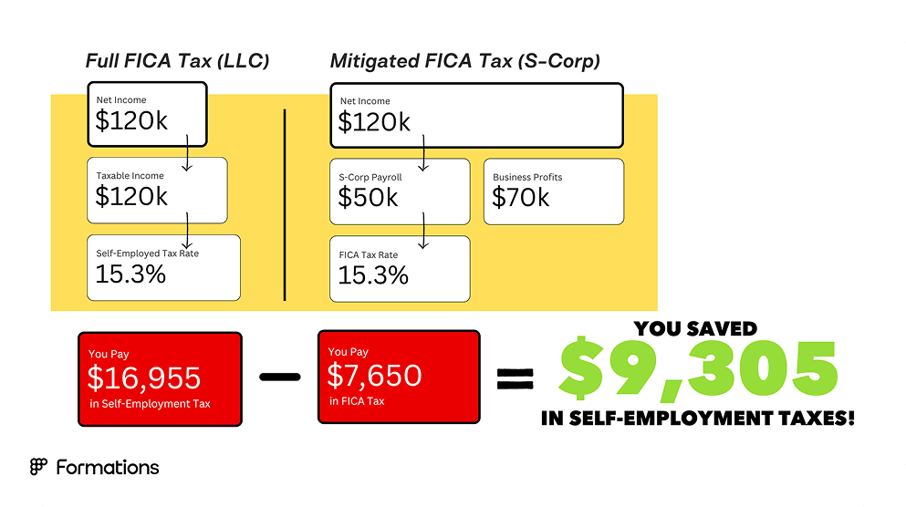
For self-employed individuals earning consistently above $60,000 in net income, S-Corporation election is one of the most powerful tax-saving strategies available. An S-Corp allows you to split business profits into salary and distributions, paying self-employment taxes (15.3%) only on the salary portion.
Consider this example: With $120,000 in net income as a sole proprietor, you'd pay approximately $17,000 in self-employment taxes. As an S-Corp paying yourself a $50,000 reasonable salary, you'd only pay $7,650 in self-employment taxes — a savings of over $9,300 annually without changing anything about how you run your business.
The S-Corp deadline for 2025 has passed, but through special provisions, you may still be able to elect S-Corp status retroactively or prepare for 2026. More importantly, starting this conversation now ensures you're positioned for maximum savings going forward.
Build Your Professional Dream Team
Self-employed professionals need their own dream team: tax advisors who understand self-employment, bookkeepers who maintain clean records, financial advisors for investment strategy, and potentially real estate agents, insurance specialists, and legal counsel.
The key is working with professionals who specialize in self-employment because the tax code offers tremendous benefits to business owners, but only if you have advisors who know how to leverage them.
Find the Right Technology
Cloud-based platforms can automate 80-90% of your back-office operations, including transaction categorization, mileage tracking, invoice management, and financial reporting. This automation frees you to focus on what matters: growing your business and making strategic financial decisions.
Platforms like Formations integrate payroll, bookkeeping, tax preparation, retirement planning, and S-Corp management into a unified dashboard, eliminating the need for multiple disconnected services.
Set Financial Goals and Plan Proactively
When you set revenue goals, profit targets, and investment priorities at the beginning of each year, tax strategies naturally flow from those objectives. Should you maximize retirement contributions? Invest in equipment? Purchase real estate? The answers depend on your broader financial vision.
Meeting quarterly with your tax advisor, rather than once a year in March, transforms taxes from a reactive burden into a proactive tool for wealth building. You'll identify opportunities early, adjust strategies as circumstances change, and avoid the year-end scramble entirely.
Build a Tax Strategy That Works All Year
We’ve outlined the most impactful tax moves you can still make this year, but the biggest savings come from a strategy built specifically for your situation. By working with Formations, you can go beyond tips and tactics to create a year-round tax plan that reduces your tax bill, uncovers additional savings opportunities, and removes the stress of last-minute decision-making. Book time with our team to see how much more you could save, and gain peace of mind knowing your tax strategy is working for you all year long.
Frequently Asked Questions
How do I know if I should switch to an S-Corporation?
S-Corporation election makes financial sense when you consistently generate net income above $60,000 annually. Below that threshold, the administrative costs and complexity may outweigh the self-employment tax savings. Above $60,000, the 15.3% self-employment tax savings on your distributions (not salary) typically justify the structure. High earners save even more, though other strategies may complement the S-Corp as income increases. Schedule a consultation with a tax professional to analyze your specific situation.
What's the deadline for making retirement contributions that count for the 2025 tax year?
The deadline varies by retirement plan type. For Solo 401(k) employee deferrals, the plan must be established by December 31st, 2025. However, employer profit-sharing contributions to a Solo 401(k) or SEP IRA can be made up until your tax filing deadline, including extensions (potentially as late as October 2026). HSA contributions can be made through April 15th, 2026, and still count for the 2025 tax year.
Is cost segregation worth it for smaller rental properties?
Cost segregation becomes worthwhile when the property value and potential depreciation acceleration justify the study cost. Properties purchased for $30,000 many decades ago typically don't benefit from cost segregation. However, recently purchased properties with values of $200,000+ often see significant tax savings. The best approach is requesting a free preliminary assessment where you'll receive an estimate of potential savings before committing to the full study, allowing you to make an informed decision.